Flow and Core Game Loops
Game loops are essential for a game to be successful; a good game loop will keep the players interested and engaged, the game developer progresses difficulty and skill as the player masters the game mechanics. Successful games create a journey of both skill and engagement incorporated with smooth game progression to create a state of flow.
Game Loops I have enjoyed.
A game I have enjoyed from my childhood up until now is Minecraft. A seemingly simple voxel based MMO experience on the surface, however, can become overly complex and overwhelming. The almost-infinite randomly generated terrain and the ability to build and destroy was a key factor in why I enjoyed the game.
Minecraft’s core game loop and why it is perfect for everyone
Minecraft has an aspect of creativity and uniqueness, the player is invited to mold the world they are put in and create amazing structures and fabricate their own challenges, of course this requires knowledge and skill to achieve. The default game does not have any dialogue nor any storyline / tutorial to guide you through the game; it puts the player right in the middle of everything and lets them adventure through the game and figure things out. This decision allows the player to create the difficulty curve they want, and lets them accomplish what they can do, not what they are forced to do.
//
The difficulty curve of Minecraft
The difficult aspect of the game is learning what everything does. There are no instructions, so you are thrown into the deep end, forced to learn from your mistakes. The game includes interesting enemies – all unique in the ways they interact with the player – for example; zombies, which spawn at night and actively seek out the player to kill them; skeletons, much like the zombies, hunt the player with a bow from long range; villagers, spawn in villages (a natural structure in the world) and provide the player with resources through trading Emeralds. Each NPC in the game has its strengths and weaknesses, some help the player, and some do not. This game mechanic is interesting as it requires skill to overcome those challenges within each interaction but rewards the player with loot and a sense of accomplishment.
What keeps Minecraft interesting for me?
Most genres of games have certain goals for the player, certain missions, or quests to keep the player interested and motivated to play the game. Minecraft is different. I personally would not say that Minecraft is a one-genre-game, it takes many aspects of different games and bundles them into one; creativity, exploration, action, sandbox, puzzle, platformer etc. This allows the player to venture into what they like to do in a game and make the game theirs.
Minecraft achieves this genre diversity by implementing multiple forms of customizability within the game. Different world types to choose from that offer variation to the world, for example; a “flat world” is a world type that is completely empty – allowing those that just want to build and have a quiet space to let their imagination flow; or a regular world type, for players who enjoy adventure and action. It is interesting for all people, not just a select few; thus, the reason it became so popular.
Another aspect of Minecraft that interests me is the more complex side of the game; Redstone and Coding. Redstone is Minecraft’s version of electricity; it is used to power certain blocks like pistons that can move blocks. I was able to explain the basics of computer science through Redstone and make myself understand different ways to represent numbers and base notations (e.g., binary and hexadecimal), logic gates, how computers store data etc. I found this fascinating, and it is the main reason I still play this game today.
//
Game loops I have not enjoyed
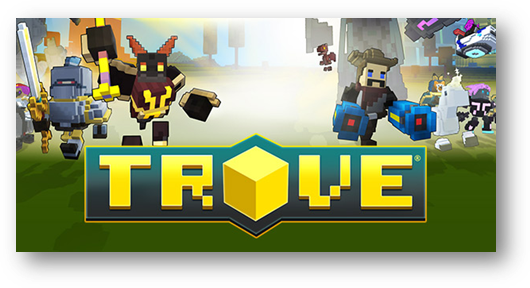
One game I have played is Trove, another simple voxel-based RPG focused on adventuring into new worlds and discovering new enemies and items. Trove seemed like a fantastic game for me as a new player, starting out with a selection of characters to play as and level up, but once you really explore into the mid/endgame it becomes difficult to continue.
Trove’s core game loop and why it is not that great
- Slow and difficult progression
Unlike Minecraft, Trove provides the player with a brief storyline and tutors the player through the basics of the game. As the player progresses through each world, the enemies change and so do their characteristics, this can make it hard for the player to keep up with the individual attack patterns and abilities of the many unique enemies.
There is a point in Trove where you can only progress through pay to win and with players who are also both time and financially invested in the game like yourself.
- Pay to win
The games company has monetized the endgame hard and with both power rank and Mastery have introduced bragging rights to such a degree that you feel inadequate as a new and mid game player.
Difficulty
Elements of the game require team completion and although there is a community and invitation system you must be a required Power CAP and players find this unachievable as a casual player.
- Repetition
Solo game in trove is repetitive; complete dungeons, get loot, as you power up the enemies get harder to kill, but nothing special changes in the game mechanics, they are just tougher. As you progress you just become faster at doing this, minimizing the time it takes to complete the dungeon, and this is the repetitive loop to the game – not very engaging and bores the player over time.
- Environment
The overall color palate is boring, environments are dull, the colors are not pleasing to the eye or relatable to the design or story of the game. The block style format, while good in Minecraft, Trove’s is clunky and does not flow which affects the player’s experience when navigating the terrain.
- Characters
Character special abilities are generic with only slight differences, Lots of different characters but no real specialization i.e., support / magic / DPS all characters are DPS. Character design is a simple, blocky look which provides no visual customization mechanic for the player base to be creative.
//
- End game
The end game is for people who pay to win, the journey between mid-game and endgame is not fluid – this is where the player base falls off.
- In Game resources / currency
Resources are time consuming and expensive. The game has a marketplace which for fresh players is far too expensive due to being flooded with resources that fresh players need, and end players have lots, so prices inflated.
- Difficulty
Bosses have far too much health which for the average player are impossible to overcome.
- Freedom to play
Weekly rewards are essential for progression, but the player must commit to grind daily to achieve. Trove has daily benefits i.e., Tuesday is gathering day rewarding double and pay to win multiple drops this means the player is compelled to play on a given day and the freedom of play is taken away for them.
Summary
To Summarize my experience with game loops and how good and bad games flow; the game must be engaging to the player, it must capture their excitement and maintain that feeling of both progression and reward while the player’s skill level increases. The game needs to be well designed for both the casual and the hardened player’s skill, progression is balanced in skill and difficulty in the flow dynamic, so it does not stagnate, and the player always feels like they are advancing. Incorporating inspirational earned cosmetics can inspire the game community at any level but must be achievable by all players. In game transactions can be both a good and bad component to a game they should however not be intrinsic to a game’s endgame as this will cause the casual player to lose interest. Title games where the player is not governed by design on how and when to play seem to trend with me and clearly are popular to the gaming community. Good structure, playability, design, and freedom to explore I believe are the fundamentals for me to keep me engaged and interested along with achievable endgame which is not stagnant.
Storyboards
What are storyboards?
A storyboard is a visual representation of a story that is used in the production of films, television shows, animations, and other visual media. Essentially, a storyboard is a series of sequential drawings that serves as a previsualization of the final product.
Storyboarding has been a critical component of the filmmaking process for more than a century. These days, storyboards are created by illustrators using digital tools, but in the past, filmmakers would draw storyboards by hand on paper.
Storyboarding is an important step in the production process for a number of reasons. First and foremost, a storyboard allows creative teams to visualize the story and plan the shots and sequences that will be used to tell it. This can help to identify potential issues and work through them before filming begins, avoiding costly mistakes and re-shoots later on.
Additionally, a storyboard can also be used as a communication tool to convey ideas and set expectations, particularly between the director, cinematographer, and production designer. The storyboard can serve as a reference point for everyone involved with the project, helping to ensure that everyone is on the same page.
Overall, storyboarding is an essential tool for visual storytelling, allowing creative teams to work through ideas, plan shots, and communicate effectively throughout the production process.
An example of a game or movie storyboard and compared to the final product.
The movie ‘Frozen’ has an almost identical storyboard compared to the final rendition.

Elegance
- Depth
Depth is the total decisions a player can make during the entire game, this is usually in the high thousands. A game with lots of depth will usually have a lot of replayability (needing to replay the game to experience parts of the game).
- Complexity
Complexity is how many decisions a player can make at any one point during the game. Games with low complexity are easy to play and have little-to-no challenge, however, high complexity will make the game difficult and
- Elegance
Elegance is a perfect balance of depth and complexity; lots of depth ( either game mechanics, replayability, etc… ) but not very complex ( easy controls and rules ).
 Lewis' Games Development Portfolio